(650) 522-4653

China Top 10 Golf Club Manufacturers for Global Buyers

Choosing a golf club supplier in China involves more than comparing catalog prices. Buyers need to understand what each manufacturer actually produces, how specifications are checked, and whether communication stays clear from sample to shipment. A polished product photo cannot answer those questions.

This guide introduces ten Chinese golf club manufacturers for global buyers and outlines practical points for evaluating them. The comparison focuses on product range, customization options, materials, production capabilities, quality-control processes, and export experience. Buyers may encounter everything from forged irons and cast clubheads to complete sets and private-label services. Details matter. A small change in shaft flex, grip size, or clubhead finish can affect the finished order.

The phrase “top golf clubs” does not mean one model suits every player or market. A manufacturer that fits a large-volume retail program may not be the right partner for a smaller custom order. Ask for current specifications, sample products, production timelines, and clear explanations of inspection procedures. Verify claims directly, and compare like with like. It is easy to overlook packaging, replacement parts, or the time needed to approve a sample. We may not know every factory’s latest capacity or internal practices from public information alone. That limitation deserves attention. Use this overview as a starting point for supplier research, then confirm details with each manufacturer before making a purchasing decision.
China Top 10 Golf Club Manufacturers for Global Buyers

China’s Golf Club Manufacturing Industry and Its Global Role

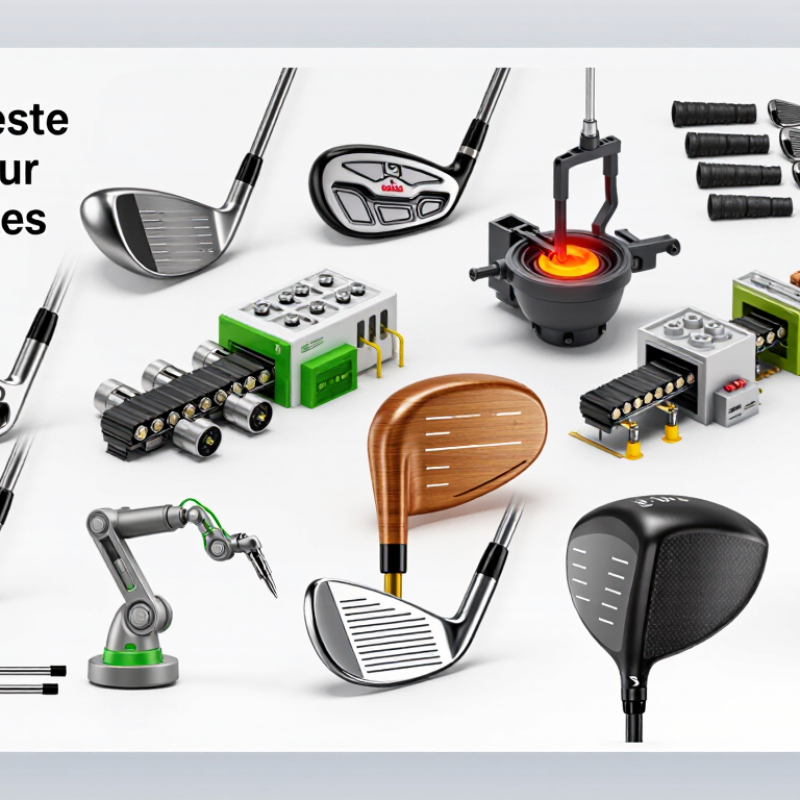
China’s golf-club manufacturing industry serves global buyers through component suppliers, assembly plants, and specialist workshops. Production may include forging or casting clubheads, fitting shafts, installing grips, applying surface finishes, and inspecting finished clubs. Details matter. Buyers need more than a competitive unit price; they need specifications that remain consistent across repeat orders.

Manufacturers may handle trial runs, custom specifications, or larger seasonal orders, depending on their equipment and capacity. Buyers can compare samples, measurement records, material information, packaging, and communication. A club that looks polished under showroom lighting still needs reliable loft, lie, weight, and finish measurements. That takes time. One sample cannot confirm stable production, so buyers should ask how checks are recorded across a full order.

China’s global role also reflects its broad industrial base. Metalworking, machining, coatings, packaging, and export services may be available within connected supply networks. This can simplify coordination, but it does not guarantee lower total costs or faster delivery. Freight schedules, tooling changes, and rework can affect a quotation. The industry is not uniform: some manufacturers focus on components, while others manage more stages of finished-club production. Clear questions about process ownership, defect handling, and specification changes can reveal gaps. Sometimes, the answers are incomplete.

How to Assess Chinese Golf Club Manufacturers

Assessing a Chinese golf club manufacturer takes more than comparing unit prices or polished product photos. Ask how the factory controls head weight, loft, lie angle, shaft alignment, and grip installation across repeat orders. Small variations matter. Request a sample set made to your specifications, then inspect it with the tools used for incoming checks. Record the measurements.

Review the production route, not just the showroom. Ask who performs forging or casting, finishing, assembly, and final checks, and whether these steps stay in-house. Request dated inspection records, material declarations, and clear defect-handling terms. These documents should match the actual model and order. An audit can help, but a single visit cannot prove every batch will be consistent. That distinction is easy to miss.

Check capacity against your forecast and ask how seasonal peaks affect lead times. Discuss tooling ownership, packaging, replacement parts, and how engineering changes are approved. Have one contact send drawings, sample revisions, and written confirmations in a shared record. Good communication is evidence, too. No checklist removes uncertainty. I would question a rushed sample approval, even when the first clubs feel excellent.

China Top 10 Golf Club Manufacturers for Global Buyers - How to Assess Chinese Golf Club Manufacturers

Use this 100-point assessment framework to compare potential manufacturers. The weights are suggested buyer priorities, not rankings or verified scores for specific suppliers.

No. Assessment Dimension What to Assess Evidence to Request or Verify Weight Buyer Check
1 Quality Management Documented controls for incoming materials, production operations, inspection, nonconformities, and corrective actions. Current quality-management certificate, if claimed; verify its validity, issuing body, covered site, and scope. Request inspection procedures and sample quality records. ISO 9001 is a quality-management-system standard, not a golf-club product approval. 15% Review documents and audit the relevant production site.
2 Materials and Process Control Ability to specify and control materials and processes used for heads, shafts, and grips. Common material options include stainless steel, titanium alloys, carbon-fiber composites, steel shafts, graphite shafts, and rubber-based grips. Material specifications, supplier certificates, process descriptions, traceability records, and test results tied to the quoted product. 12% Match documented materials to samples and purchase specifications.
3 Product Testing and Conformity Testing relevant to the intended market and product design, including dimensional checks and any applicable golf-equipment conformity requirements. Test plans and reports identifying the model, test method, date, and responsible laboratory. For products marketed as conforming to golf rules, confirm the applicable requirements with the relevant governing-body resources. 12% Confirm that reports cover the exact design and production model.
4 Product Range and Technical Capability Relevant experience with the buyer’s intended club types, such as drivers, fairway woods, hybrids, irons, wedges, and putters, as well as head, shaft, and grip assembly. Product drawings, technical specifications, representative samples, and clear statements of which processes are performed in-house or subcontracted. 10% Check capability against the actual product brief, not a general catalogue.
5 Customization and Engineering Support Capacity to work from buyer requirements for design, dimensions, finishes, markings, packaging, and component combinations. Design-review process, revision-controlled drawings, sample approval workflow, and written confirmation of intellectual-property and tooling ownership terms. 10% Approve a documented specification before mass production.
6 Prototyping and Tooling Clarity and control over prototype development, tooling creation, design changes, and production approval. Prototype schedule, tooling quotation, tooling maintenance plan, change-control records, and contractual terms covering storage, access, and ownership. 10% Confirm tooling terms and approve a production-representative sample.
7 Production Capacity and Lead-Time Control Realistic capacity for the required order volume, seasonal demand, and agreed delivery schedule. Capacity plan, production schedule, bottleneck information, subcontracting disclosures, and records or references supporting stated lead times. 8% Validate capacity with a trial order and milestone-based schedule.
8 Export and Market Requirements Experience preparing shipments and product documentation for the buyer’s destination market. Applicable requirements vary by country and product claims. Sample commercial and shipping documents, packaging details, and evidence relevant to the specific destination-market requirements. Confirm obligations with the importer or qualified compliance adviser. 8% Check requirements for the destination country before placing the order.
9 Commercial Terms and Cost Transparency Clear quotation details, payment terms, minimum order quantities, sample charges, tooling costs, and treatment of price changes. Itemized quotation, written order terms, product specification, delivery terms, and a defined process for approving changes. 7% Compare like-for-like specifications and total landed cost.
10 Communication and Traceability Responsiveness, clarity in technical discussions, and ability to trace production lots and address quality issues. Named project contacts, meeting records, sample and revision logs, batch identification method, and corrective-action procedure. 8% Test communication during sampling and a small initial order.
Total Suggested Assessment Weight 100% Score each item against documented evidence.

Assessment note: This framework compares supplier capabilities and verification evidence; it does not identify or rank individual companies. Confirm all specifications, certifications, test reports, and contractual terms directly with the relevant supplier before ordering.

Profiles of 10 Chinese Golf Club Manufacturers for Global Buyers

Profiles of ten Chinese golf club manufacturers should help global buyers compare production strengths, not simply prices. The R&A’s Global Golf Participation Report 2023 recorded 61 million on-course golfers across 146 countries. That varied player base calls for different club designs, from forgiving drivers for beginners to precise head weighting for experienced golfers. Small details matter. A useful profile should explain whether a factory handles clubheads, shafts, assembly, or only selected processes.

Buyers can compare materials, stated tolerances, production capacity, and sample lead times across the ten profiles. Ask how each supplier checks loft, lie angle, swing weight, and finish consistency. Request test records, not just catalog claims.

A glossy sample can mislead. I would not treat one sample as proof; batch-to-batch consistency deserves equal attention.

The R&A report describes participation, not purchasing demand, so it cannot verify a factory’s quality or export performance. Profiles should make that distinction clear and avoid unsupported claims. For practical checks, buyers can request a sample set, inspect ferrule alignment and grip fit, then compare measured specifications with the order sheet.

Product Categories, Customization, and Manufacturing Capabilities

Global buyers comparing China-based golf-club manufacturers should assess product range, customization, and process control—not catalog size alone. The R&A’s Global Golf Participation Report 2023 counted about 61 million on-course golfers across 146 countries. National Golf Foundation reporting put U.S. on-course participation at 26.6 million in 2023. These figures indicate a broad player base, not guaranteed orders for any one design.

Compare woods, hybrids, irons, wedges, and putters. Check whether sampling covers left- and right-handed heads, loft and lie options, head weights, finishes, and shaft or grip choices. Fit matters. Ask how prototypes are measured, revised, and approved before production. For metal heads, discuss forging or casting, CNC finishing, heat treatment, surface coating, and dimensional inspection. Capabilities vary by factory and product line.

Request written tolerances, material specifications, batch inspection records, and a sample matched to the final bill of materials. The reports above describe participation, not factory performance. A polished sample can still conceal variation between production batches. That is the uncomfortable part: customization adds value only when repeatability is verified. Compare pre-production and random production units, then record defects and corrective actions.

Quality Control, Export Services, and Supplier Selection Factors

For global buyers comparing golf club manufacturers in China, quality control should be visible, not just promised. Ask how each production batch is checked for clubhead weight, shaft flex, grip fit, and finish. Request the inspection criteria in writing, including acceptable measurement tolerances. A sample can reveal a loose grip or uneven coating. It cannot represent every club in a large order.

Check whether the supplier can provide pre-shipment inspection records and clear procedures for handling defects. Ask to review a production sample against the approved specifications before confirming the full order. No checklist catches everything. Even careful checks leave room for doubt: one sample is not the whole production run, and buyers should plan for that limitation.

Export service matters just as much as manufacturing consistency. Confirm carton dimensions, protective packaging, production lead times, and which shipping documents the supplier prepares. Ask who will communicate if a shipment is delayed or an item needs rework. Compare several suppliers using the same questions, rather than relying on polished photos or a low quote alone. Pay attention to how promptly they answer technical questions; vague replies can make small problems harder to resolve across time zones.

Golf Club Supplier Selection: Suggested Buyer Scorecard

Suggested evaluation weights for comparing golf club manufacturers. Quality control, export documentation, capacity, customization, delivery reliability, and after-sales support are practical sourcing criteria. The percentages are a configurable scorecard framework, not measured market statistics or ratings of specific suppliers.

Contact Us

Phone: (650) - 522-4653 (GOLF)

Fax: (650) 522-7511

Tee Time Reservations: (650) 522-4653 (GOLF)

Location

1700 Coyote Point Drive

San Mateo, CA 94401