10 Tips for Buying Municipal Golf Course Equipment?
Buying equipment for a municipal golf course involves more than comparing prices and horsepower. Public courses serve varied golfers, operate under strict budgets, and face constant pressure to maintain playable turf. A mower that performs well on a private course may struggle with heavy daily use, wet fairways, or limited storage space. Small errors compound.
This guide introduces ten practical tips for evaluating equipment with greater confidence. It considers cutting quality, fuel or battery performance, operator comfort, service access, parts availability, and total ownership costs. Grounds managers should inspect machines in realistic conditions, not only inside a dealer’s showroom. Ask how quickly replacement parts arrive. Check whether local technicians understand the model. Speak with other municipal operators about breakdowns, seasonal workload, and long-term reliability.
The cheapest bid can mislead. A lower purchase price may hide expensive batteries, frequent repairs, or specialized tools. Conversely, premium equipment is not automatically the right choice. Fleet compatibility, training requirements, terrain, and staff experience deserve equal attention. Manufacturer specifications provide useful evidence, but field feedback often reveals practical weaknesses.
No checklist is perfect. Weather changes, staffing shortages, and unexpected funding limits can alter a sound purchasing plan. Honest evaluation includes documenting those risks before approval. By combining verified specifications, maintenance records, operator feedback, and responsible budgeting, buyers can protect course conditions and public resources. The goal is dependable equipment that supports safer work, consistent playing surfaces, and sustainable municipal operations.
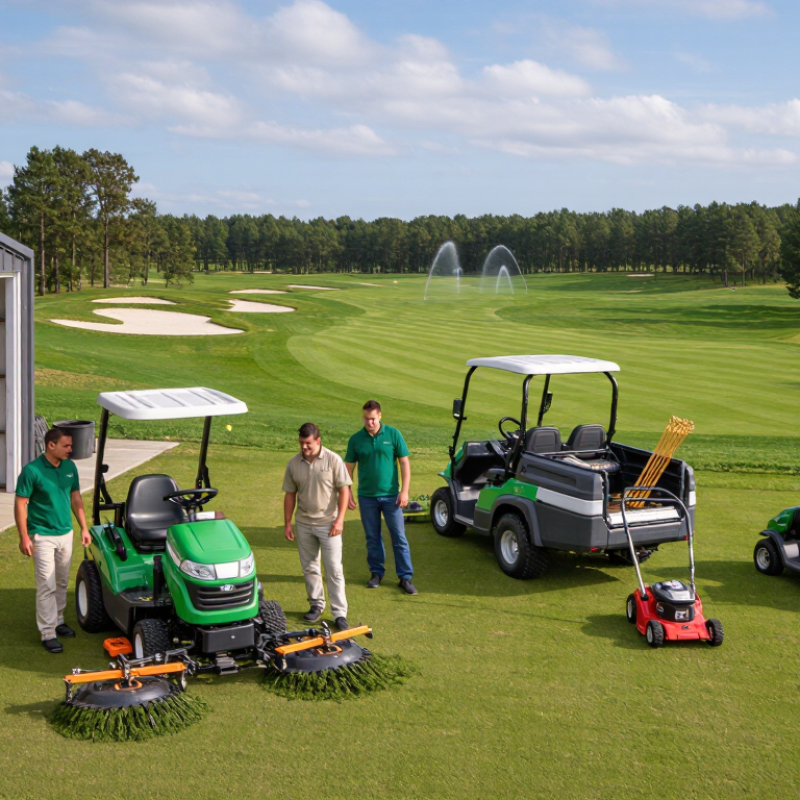
Assess Course Needs and Equipment Priorities
A municipal fleet should begin with evidence, not a catalog. Walk every hole with the superintendent and operators. Record turf type, mowing hours, slopes, narrow paths, bunker edges, and irrigation access. Measure downtime during the busiest weeks. Small details matter.
The GCSAA Golf Course Environmental Profile reported a 21% decline in total golf-course water use between 2005 and 2015. That finding supports prioritizing efficient irrigation tools, leak detection, and equipment that reduces turf stress. However, water savings should not outrank urgent safety repairs. A failing mower deck can create poor cuts, longer workdays, and frustrated staff. Weigh risk, labor, performance, and maintenance access together.
The National Golf Foundation’s 2024 Golf Facilities in the U.S. report identifies public facilities as roughly three-quarters of American golf facilities. Municipal courses therefore face public-service pressure and tight budgets. Select equipment by total cost of ownership, not purchase price. Compare fuel or energy use, expected service hours, parts availability, operator training, and resale value. Standardizing key components can simplify repairs, but too much standardization may limit specialized work. I have seen fleets look efficient on paper while operators quietly avoid difficult machines. Ask them why. Then test shortlisted equipment on wet turf, steep approaches, and crowded maintenance routes before approval.
10 Tips for Buying Municipal Golf Course Equipment: Assess Course Needs and Equipment Priorities
Prioritize equipment by its effect on playing conditions, daily maintenance, safety, labor efficiency, and service continuity. The 1–5 scores below are a practical planning assessment for a typical municipal golf course.
Higher scores indicate equipment categories that generally deserve earlier budget attention. Mowing equipment, irrigation systems, and utility vehicles often affect course conditions and operational reliability across the greatest number of daily tasks.
Set a Sustainable Budget and Total Cost Framework
Municipal golf course equipment should serve golfers, staff, and public budgets for many seasons. A low purchase price can hide repair labor, battery replacement, fuel, storage, training, and disposal costs. Build a total cost framework before requesting quotations. Record the expected purchase price, annual operating cost, maintenance schedule, useful life, and resale or disposal value. Use local service records when available. They are more reliable than optimistic sales estimates.
Tip 1: Set a five-to-eight-year ownership forecast. Include seasonal usage, harsh weather, transport distance, and staff hours. A mower used daily may cost more than its invoice suggests. Ask maintenance supervisors to review the assumptions. Their practical experience can expose missed costs, such as spare cutting units or winter storage preparation. I have seen budgets fail because small recurring expenses were treated as exceptions. That mistake is easy to repeat.
Tip 2: Protect a contingency reserve of roughly 10% to 15%, depending on equipment age and site conditions. Compare leasing, purchasing, and shared municipal ownership with the same total cost method. Check warranty limits, training support, parts availability, and expected downtime. The cheapest option may create lost mowing windows and uneven playing surfaces. Revisit the framework each year. Some estimates will be wrong. That is normal, but ignoring them is not.
Compare Equipment Types, Specifications, and Compatibility
When buying municipal golf course equipment, compare equipment types before comparing prices. Reel mowers create precise playing surfaces, while rotary mowers handle rough areas and wider paths. Utility vehicles support transport, waste collection, and maintenance tasks. Aerators improve compacted soil, but their working width and penetration depth must match course conditions. Irrigation equipment requires different checks, including flow rate, pressure, coverage, and control compatibility.
Specifications should reflect daily workloads, not impressive brochure numbers. Measure cutting width against narrow paths, tree lines, and bunker edges. Check engine or battery capacity for a full maintenance shift. Confirm turning radius, ground clearance, noise levels, and storage dimensions. Small details matter. A heavy machine may damage wet turf, even when it performs well on dry ground. Operators should test controls while wearing gloves and working on slopes.
Compatibility often decides whether equipment becomes useful or expensive. Confirm attachment mounts, hydraulic connections, charging systems, tire sizes, and spare-part availability. Existing trailers and maintenance tools must fit the new unit safely. During one site assessment, a machine met every listed specification but could not enter the equipment shed without removing its canopy. That mistake was avoidable. Request demonstrations on actual turf, review service records, and let experienced grounds staff inspect the machine. Specifications can be correct. The match can still be wrong.
10 Tips for Buying Municipal Golf Course Equipment? - Compare Equipment Types, Specifications, and Compatibility
| Tip | Equipment Type | Primary Use | Typical Specifications to Compare | Compatibility Checks | Municipal Buying Consideration |
|---|---|---|---|---|---|
| 1 | Reel Mower | Close, precise mowing of greens and other fine turf areas. | Cutting width commonly about 46–76 cm; reel diameter, number of blades, height-of-cut range, number of cutting units, and power source. | Confirm that the cutting units accept the required groomers, brushes, rollers, and bedknife options. | Prioritize consistent cut quality, simple reel adjustment, corrosion-resistant components, and access to sharpening support. |
| 2 | Fairway Mower | Maintaining fairways and broad areas of closely cut turf. | Typical cutting width about 1.8–2.5 m; number of reels, transport width, height-of-cut range, turning radius, and ground pressure. | Check compatibility with the course’s maintenance paths, trailer width, storage doors, and turf-management attachments. | Compare productivity against slope performance and turf compaction; a wider unit is not always suitable for narrow access routes. |
| 3 | Rotary Mower | General mowing of roughs, native areas, and less finely maintained turf. | Cutting width often about 1.5–3.0 m; blade tip speed, deck construction, height adjustment, engine power, and discharge or mulching configuration. | Verify deck clearance, PTO or hydraulic requirements, hitch type, and compatibility with the towing or carrier vehicle. | Evaluate safety shielding, debris management, noise, fuel use, and the ability to handle varied grass height. |
| 4 | Rough Mower | Efficient mowing of roughs, slopes, perimeter areas, and naturalized turf. | Common working widths range from about 2.0–3.5 m; compare deck articulation, slope rating, cutting height, tire configuration, and traction control. | Measure bridge, gate, and path widths; confirm rollover protection, four-wheel-drive operation, and trailer capacity. | Safety and terrain capability should be assessed before maximum cutting width or theoretical hourly output. |
| 5 | Utility Vehicle | Transporting staff, tools, materials, clippings, and maintenance attachments. | Compare payload, towing capacity, cargo-bed dimensions, turning radius, ground clearance, braking system, and electric or combustion power. | Match the vehicle to spreaders, sprayers, dump bodies, trailers, charging infrastructure, and existing attachment interfaces. | Calculate total operating cost, including energy, routine service, batteries, tires, insurance, and expected annual hours. |
| 6 | Core Aerator | Relieving compaction and improving air and water movement in the root zone. | Compare working width, tine diameter, coring depth, hole spacing, operating speed, and required tractor or carrier power. | Confirm three-point hitch category or tow connection, hydraulic requirements, PTO speed, and available tine sizes. | Select settings that suit greens, tees, fairways, or sports-turf areas; verify that extracted cores can be collected or managed. |
| 7 | Topdresser | Applying measured quantities of sand or soil amendment to turf surfaces. | Compare hopper capacity, spreading width, application-rate range, belt or spinner system, calibration method, and loaded weight. | Check payload limits, material moisture tolerance, towing or PTO requirements, and compatibility with the maintenance vehicle. | Calibration repeatability is essential; choose a unit that can apply the planned material volume without overloading access paths. |
| 8 | Turf Sprayer | Applying water, fertilizers, plant-protection products, and approved turf treatments. | Compare tank volume, boom width, pump output, pressure range, nozzle spacing, filtration, agitation, and application-rate controls. | Ensure the system supports the required nozzle standards, GPS or rate-control equipment, tank-cleaning process, and vehicle payload. | Include chemical-handling safety, operator training, drift reduction, spill control, and local regulatory requirements in the specification. |
| 9 | Bunker Rake | Raking sand bunkers and maintaining bunker edges and contours. | Compare working width, rake depth adjustment, tire footprint, steering configuration, ground clearance, and attachment options. | Measure bunker entrances and confirm that the unit can negotiate slopes without excessive sand displacement or turf damage. | Low ground pressure, precise steering, and easy access to rakes and teeth can reduce daily labor and repair time. |
| 10 | Leaf and Debris Management Equipment | Collecting leaves, clippings, cores, branches, and other course debris. | Compare collection volume, suction or blower capacity, hose diameter, operating noise, filtration, unloading height, and towing weight. | Verify connection sizes, PTO or hydraulic flow, trailer limits, access to composting areas, and compatibility with collection bags or containers. | Choose capacity based on peak seasonal volume rather than average daily demand, and confirm safe unloading procedures. |
Specification note: The ranges shown are typical purchasing benchmarks, not fixed standards. Actual performance depends on configuration, turf conditions, terrain, maintenance practices, local regulations, and the selected attachments.
Evaluate Suppliers, Warranties, Service, and Operator Support
10 Tips for Buying Municipal Golf Course Equipment
Municipal courses need equipment that survives public use, tight budgets, and uneven operator experience. The National Golf Foundation’s 2024 Golf Industry Report recorded about 531 million U.S. rounds in 2023. That volume makes equipment uptime a financial issue, not a technical luxury. Ask suppliers for documented response times, local technician coverage, and parts availability. A low purchase price means little when one mower waits three weeks for a belt.
Compare warranties line by line. Check coverage periods, excluded wear parts, labor reimbursement, transport costs, and approval procedures. Require written service-level commitments, including emergency support during peak mowing periods. GCSAA’s 2023 Golf Course Maintenance Operations Survey identifies labor and maintenance costs as continuing operational pressures. Therefore, evaluate operator training as carefully as horsepower. Practical demonstrations should cover daily inspections, blade or reel adjustment, battery safety, cleaning, and fault reporting.
Do not accept vague promises. Ask for three municipal references with similar acreage and staffing. Review total cost over five years, including fuel, batteries, attachments, training, and disposal. I have seen buyers overvalue specifications and undervalue familiar controls. That judgment can fail. Operators should test visibility, vibration, seat adjustment, and access to service points before purchase. A useful scoring sheet might assign 30 percent to reliability, 25 percent to service, 20 percent to warranty, 15 percent to training, and 10 percent to price. Revise those weights after speaking with the crew. Their objections may reveal risks that a polished sales presentation hides.
Plan Procurement, Testing, Maintenance, and Replacement
Municipal golf equipment purchases should begin with service levels, not shiny specifications. Define mowing height, daily acreage, noise limits, slope access, and seasonal workload. Build an inventory with age, operating hours, downtime, parts availability, and operator feedback. Price fuel, batteries, attachments, training, storage, and disposal—not only the invoice. The U.S. Department of Energy’s Operations & Maintenance Best Practices Guide reports that preventive maintenance can reduce maintenance costs by roughly 12–18 percent. That figure deserves caution. Golf-course conditions vary, and our first replacement spreadsheet was too optimistic.
Write procurement specifications around measurable performance. Require demonstrations on wet turf, tight turns, bunker edges, and transport routes. Record cut quality, noise, charging or refueling time, vibration, and recovery after stoppage. Let mechanics and operators score trials independently. A short field test can expose a poor access panel faster than a polished presentation. The U.S. Environmental Protection Agency’s ENERGY STAR Buildings Upgrade Manual cites 5–20 percent energy savings from effective operations and maintenance. For electric units, measure charger demand and battery life under real municipal schedules.
Maintenance needs an owner and a calendar. Use hour-based inspections, seasonal service windows, blade or reel measurements, tire checks, fluid sampling, software updates, and documented safety checks. Keep common wear parts available, but avoid stocking everything. Review downtime monthly. Replace equipment when repair costs, lost playing hours, and operational risks exceed planned ownership costs. Set that trigger before failure. Operators may skip logs when staffing is thin. Plan for that reality.
Related Posts
-
Why Choose Sunset Golf Course for Your Next Golf Trip?
-

7 Best Peninsula Golf Courses for International Travelers?
-

Top 10 Peninsula Golf Courses You Must Play?
-

China Top 10 Municipal Golf Course Suppliers
-

Top Old Course Golf Equipment Suppliers for Global Buyers?
-

Exploring the Art of Golf Course Design and Its Impact on the Game

Contact Us
Phone: (650) - 522-4653 (GOLF)
Fax: (650) 522-7511
Tee Time Reservations: (650) 522-4653 (GOLF)
Location
1700 Coyote Point Drive
San Mateo, CA 94401