(650) 522-4653

How to Find Reliable Menstrual Cup Manufacturers

Choosing trustworthy Menstrual Cup Manufacturers requires more than comparing unit prices or polished websites. The right supplier must prove product safety, material consistency, manufacturing control, and dependable communication. A menstrual cup touches sensitive tissue for several hours. Small defects can matter.

Market reports show why this sourcing decision deserves care. Grand View Research estimates that the global menstrual cup market will continue expanding through 2030, supported by reusable-product demand and rising menstrual-health awareness. Fortune Business Insights reports similar growth, although market estimates differ by research method and regional coverage. That difference is important. No single report should guide a supplier decision.

UNICEF’s Guidance on Menstrual Health and Hygiene emphasizes safe, informed, and dignified menstrual-product use. It also highlights the importance of water, sanitation, privacy, and reliable information. These factors should influence manufacturer evaluation, not just marketing claims. Ask for material specifications, batch records, laboratory test results, and documented quality procedures. Look closely at silicone grades, cup hardness, rim finishing, packaging cleanliness, and odor after sterilization. Request samples from different production batches. Compare them under real handling conditions.

A credible factory welcomes detailed questions. It should explain its testing scope, corrective-action process, and traceability system. Certifications help, but certificates alone are not proof of consistent performance. That is an uncomfortable lesson. Some suppliers present impressive documents while offering weak production evidence. Independent verification remains valuable. This guide examines practical checks, essential questions, and warning signs. The goal is not the cheapest factory. It is a manufacturer capable of producing safe, consistent, and user-centered menstrual cups over time.
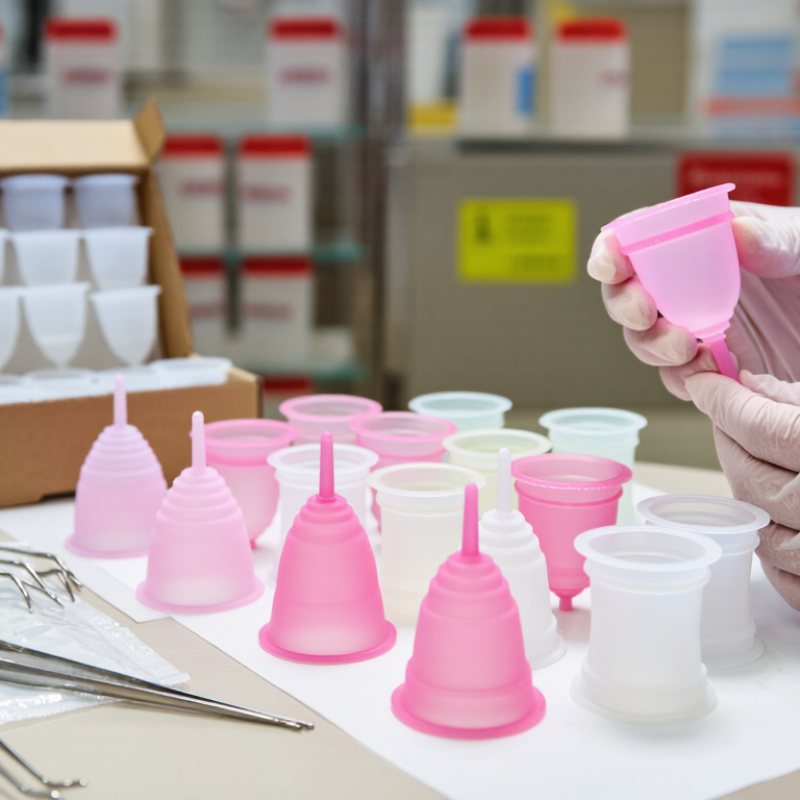
How to Find Reliable Menstrual Cup Manufacturers

Define Product Criteria: ISO 10993 Safety and 8–12-Hour Use

Reliable menstrual cup manufacturers should begin with defined safety criteria, not attractive packaging.

ISO 10993 provides a biological evaluation framework for materials contacting the body. Ask for documented testing on cytotoxicity, irritation, and sensitization.

Request the full laboratory reports, not only a compliance statement. Check the tested material, batch number, test method, and laboratory qualifications. Missing details deserve questions.

An 8–12-hour wearing claim also needs evidence. It should reflect material safety, airflow, capacity, cleaning instructions, and real-use testing.

A 2019 systematic review in The Lancet Public Health examined 43 studies involving 3,319 participants. It found menstrual cups were generally safe and effective, but leakage still occurred for some users.

That matters. A longer claim is not automatically a better claim.

Manufacturers should explain how the cup performs across different flow levels and body conditions. Ask whether testing included repeated cleaning cycles and extended contact simulations.

ISO 10993 does not prove every product is safe forever. It supports a risk-based evaluation.

I would also question reports with perfect results and no limitations. Real testing has variation.

Supplier audits, traceable production records, and retained samples strengthen reliability. A careful review may feel slower, but rushed documentation can create larger problems later.

Verify Factory Quality Systems Through ISO 13485 Certification Records

How to Find Reliable Menstrual Cup Manufacturers

Verify Factory Quality Systems Through ISO 13485 Certification Records

A reliable manufacturer should show more than a polished product sample. Ask for its ISO 13485 certificate and verify the record independently. ISO 13485 covers medical-device quality systems, including risk controls, traceability, complaints, and corrective actions. The ISO Survey 2023 recorded more than 38,000 ISO 13485 certificates worldwide. Source: ISO Survey 2023, ISO.org. This scale shows adoption, not automatic competence.

Check the certificate number, legal factory name, manufacturing address, scope, issue date, expiry date, and certification body. Confirm the certification body’s accreditation through its national accreditation service or IAF CertSearch, where available. The scope should mention relevant product activities, not only “trading” or “general medical devices.” A factory may certify one site while outsourcing production elsewhere. Ask for redacted supplier records, material specifications, batch records, and biocompatibility evidence.

Do not trust a PDF alone. Request the latest surveillance-audit status and evidence of closed nonconformities. ISO 13485 certification supports process confidence, but it does not prove every menstrual cup is safe or comfortable. WHO guidance on menstrual health emphasizes safety, acceptability, and informed use. Product validation still matters. I would sample several batches. One missing record can reveal a weak system. This check takes time. Skipping it creates a harder question later: what exactly was verified?

Check U.S. Compliance Using FDA Device-Listing Data

How to Find Reliable Menstrual Cup Manufacturers

The U.S. menstrual cup market requires careful regulatory checking. Grand View Research estimated the global menstrual cup market at USD 1.26 billion in 2022, with growth expected through 2030. This expansion attracts capable factories, but also creates more documentation gaps. Start with the FDA Establishment Registration and Device Listing database. Search the manufacturer’s exact legal name, facility location, device listing number, and product code. Menstrual cups are regulated medical devices in the United States. However, registration and listing do not mean FDA approval. That distinction matters.

Tips: Request the manufacturer’s FDA listing record directly. Compare it with the public FDA database. Check whether the listed activity matches actual manufacturing. Review the device description, facility address, and listing status. Ask for ISO 13485 certification, biocompatibility testing, and material specifications. FDA’s database is useful, but it is not a complete quality audit. A listing can support credibility. It cannot replace an on-site inspection.

Reliable sourcing also requires evidence beyond a database entry. Review batch records, sterilization controls, complaint procedures, and change-control documents. Ask how silicone or other materials are traced from supplier to finished cup. The FDA’s 2024 Quality Management System Regulation update reinforces the importance of controlled manufacturing records. Still, paperwork can look impressive and remain incomplete. I would treat missing test methods as a warning, not a minor inconvenience. Check claims carefully, especially statements using “FDA approved.” For most purchasing decisions, “FDA registered and device listed” is more precise, but it is not a guarantee of performance.

How to Find Reliable Menstrual Cup Manufacturers

FDA device-listing verification checklist for U.S. market sourcing

Each bar represents a core verification checkpoint when reviewing FDA Device Registration and Listing data. A listing record should be matched with the product category, device name, listing status, and establishment details. FDA registration or device listing alone does not mean that the product is FDA-approved, FDA-cleared, or endorsed by the agency. For foreign manufacturers, also verify the U.S. agent and confirm any applicable premarket requirements.

Reference: FDA Device Registration and Listing Database and FDA guidance on establishment registration and device listing.

Audit Silicone Grade, Migration Tests, and ISO 10993 Reports

How to Find Reliable Menstrual Cup Manufacturers

A reliable audit starts with silicone traceability, not a glossy certificate. Ask for the exact silicone grade, supplier, cure system, pigment details, and batch records. Medical-grade silicone should have a complete Certificate of Analysis for each production lot. Check volatile residues, hardness, tensile strength, and post-curing controls. These details expose weak quality systems quickly. A 2019 Lancet Public Health review assessed 43 studies involving 3,319 participants. It found menstrual cups generally comparable with other products, but leakage and adverse events still appeared in some reports. Material consistency remains important. (van Eijk et al., 2019)

Migration testing needs practical detail. Request extractables and leachables testing under simulated use conditions, including temperature, contact time, cleaning cycles, and suitable chemical simulants. A single water extract is not enough. The report should identify the tested lot and laboratory method. Review volatile compounds, metals, colorants, and residual catalysts. Do not accept “non-toxic” as test evidence.

ISO 10993 reports must match the product’s contact type and duration. Look for chemical characterization under ISO 10993-18, cytotoxicity under ISO 10993-5, and irritation or sensitization assessments under ISO 10993-23 and ISO 10993-10. ISO 10993 compliance is not a blanket safety certificate. It is a risk-based evaluation. I would question reports using unrelated samples or missing extraction conditions. Even experienced buyers miss this detail. WHO and UNICEF estimated 1.8 billion people menstruate globally in 2024, increasing the need for dependable, traceable manufacturing. (WHO/UNICEF JMP, 2024)

Compare MOQ, Defect Rates, Lead Times, and Reuse-Life Claims

How to Find Reliable Menstrual Cup Manufacturers

A reliable manufacturer should be compared through evidence, not attractive quotations. MOQ matters, but a small order can still carry higher unit costs. Ask whether the MOQ applies per color, size, or total order. Request a clear defect-rate calculation, including the inspected quantity and rejected units. A reported “low defect rate” means little without its denominator. Review batch records, inspection procedures, and sample results before approving production.

Lead times also need careful separation. Confirm tooling, sampling, material purchasing, production, inspection, and shipping dates. A factory may quote 25 days, but approvals can add two weeks. Use a written timeline with decision points. For reuse-life claims, ask how many cleaning cycles were tested, under what temperature, and with which method. Look for evidence of changes in elasticity, surface condition, odor, and shape. Marketing language is not testing.

Tips: Order samples from different production batches. Measure rim consistency and check for flashing. Ask for retained samples and corrective-action records. Keep your own inspection notes. Perfect control is unlikely. Even careful teams can miss a small edge defect. Recheck the first shipment, especially after a supplier changes materials, molds, or operators. Reliability grows from repeated verification, not one successful sample.

Contact Us

Phone: (650) - 522-4653 (GOLF)

Fax: (650) 522-7511

Tee Time Reservations: (650) 522-4653 (GOLF)

Location

1700 Coyote Point Drive

San Mateo, CA 94401