How to Find a High Quality Electronic Dino Supplier in 2026
An electronic dinosaur is more than a molded shell with flashing eyes. Inside, small motors, speakers, switches, and battery contacts must work together through repeated play. A High-Quality Electronic Dino Supplier should therefore prove more than attractive packaging. Buyers need consistent samples, clear component specifications, and evidence that quality checks are part of production.
The opportunity is substantial, but quality cannot be assumed. Grand View Research estimated the global toys market at USD 108.7 billion in 2023 and projected 4.5% annual growth from 2024 to 2030. That broad market figure is not a forecast for electronic dinosaurs. It does show why product differentiation matters. W. Edwards Deming, a leading quality-management expert, put the principle simply: “Quality is everyone’s responsibility.” For buyers, that means asking who checks wiring, sound output, moving parts, and finished units—and how defects are recorded.
Look closely. Request a working sample and test its buttons, movement, and sound repeatedly. Ask for inspection records, material details, and written confirmation that production units will match the approved sample. Check how the supplier handles a failed batch, not only how it presents a successful one. No checklist catches everything. A sample can pass on Monday and fail after weeks of play. That uncertainty deserves attention, not polished promises. This guide explains practical ways to compare suppliers, verify claims, and make a more informed sourcing decision in 2026.
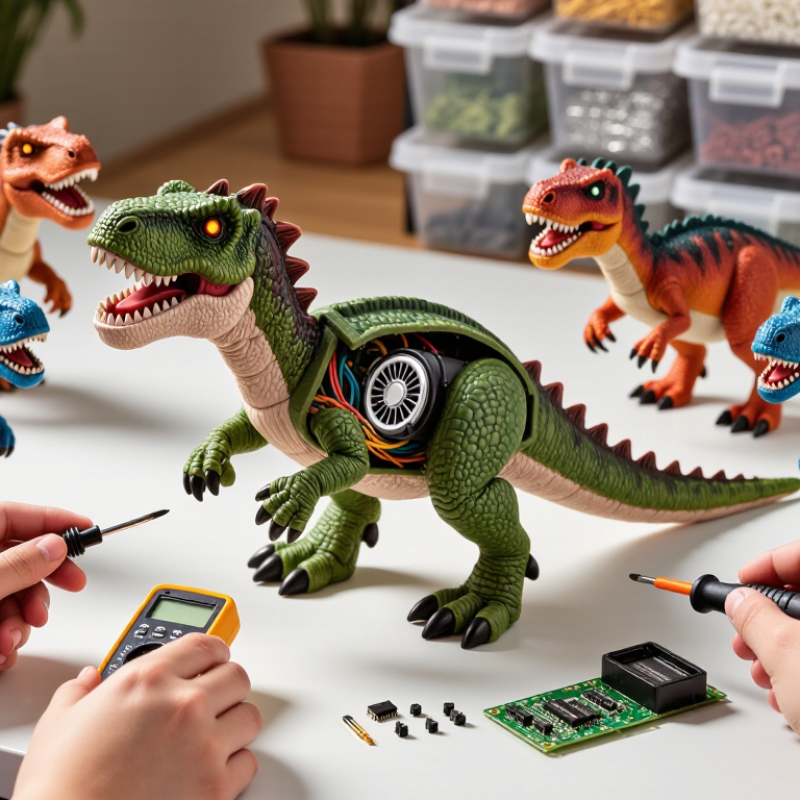
Define Dino Requirements Using ASTM F963-23 and EN 71 Toy-Safety Standards
When sourcing an electronic dinosaur, turn ASTM F963-23 and EN 71 into a feature-by-feature safety brief. List its age range, moving jaws, removable accessories, lights, sounds, and battery type. These details affect which hazards need assessment. ASTM F963-23 addresses toy safety in the United States, while EN 71 includes separate parts for mechanical and physical properties, flammability, and certain elements in materials. Requirements vary by market and product. Confirm the applicable editions and rules with a qualified testing professional.
Ask suppliers for test reports covering the exact model, materials, and production configuration—not a similar dinosaur. Check that battery compartments resist access by young children where required. Review small detachable pieces, sharp edges, sound levels, wiring, and heat during operation. Request material specifications and records showing changes were controlled. Reports matter. A practical review can still miss a detail, especially when a supplier changes a component after testing. Treat unexplained substitutions as a reason to pause and verify.
Tips: Share clear product drawings and age grading before requesting quotes. Ask which standard clauses apply to each feature, and who arranges independent testing. Keep samples, reports, and approved component lists together. If a claim sounds broad, ask for evidence. A certificate alone may not show that the tested sample matches the final product.
How to Find a High-Quality Electronic Dino Supplier in 2026
Define requirements using ASTM F963-23 and EN 71 toy-safety standards
Small-parts test cylinders are a useful reference when reviewing access to small components, but these dimensions alone do not demonstrate toy compliance. Ask suppliers for test reports applicable to the finished electronic dinosaur, its intended age grade, and the relevant requirements of ASTM F963-23 and EN 71. ASTM inch dimensions are converted to millimetres; minor differences reflect rounding.
Reference: ASTM F963-23 small-parts test fixture (1.25 in × 2.25 in); EN 71-1 small-parts cylinder (31.7 mm × 57.1 mm). Confirm details against the applicable editions and test method.
Verify CPSC Limits: 100 ppm Lead and 0.1% Restricted Phthalates
When evaluating an electronic dinosaur supplier, ask for test reports tied to the exact model, not a similar toy. For children’s products, CPSC rules generally limit total lead content in accessible components to 100 ppm. Lead in surface coatings has a separate, lower limit. Certain phthalates are restricted to no more than 0.1% in accessible parts. Not every part.
Check which components the report covers. A plastic tail, painted eye, soft charging-port cover, and wire insulation may use different materials. Ask whether the testing covers each accessible material and the specific restricted phthalates. Confirm the laboratory, test date, model number, and sample description. A report with a matching product photo is not enough if the tested sample differs from the production version.
Ask how the supplier controls changes to paint, plastic, or assembly sites after testing. Request written notice before substitutions, and keep the response with the report. That detail matters. A clean result is useful, but it does not automatically prove every production unit is identical. I still double-check. If a document is unclear, ask for the relevant pages or independent testing before placing an order.
Audit Factory Controls With ISO 9001 and ISO 2859-1 AQL Sampling
A high-quality electronic dinosaur supplier should be able to show how quality is controlled, not just point to a certificate. ISO 9001 provides a framework for documented processes, corrective actions, and continual improvement. During an audit, ask to see recent inspection records, staff training logs, and how the factory handles a failed motor or loose wire. Look for records tied to specific production batches. Small details matter.
ISO 2859-1 helps buyers plan attribute-based sampling, including AQL levels, inspection levels, and acceptance criteria. For a dinosaur toy, sampled units might be checked for walking function, sound, paint coverage, and secure battery doors. Confirm the lot size and sampling plan before inspection begins. Agree on defect categories and rejection limits in writing. AQL sampling informs a decision about a lot; it does not prove every unit is defect-free.
Check that measuring tools are calibrated and that failed samples trigger documented follow-up. Ask whether corrective actions were verified on a later production run. A polished audit file can still hide a rushed shift, so compare paperwork with the actual line and finished cartons. One visit is not enough. Supplier controls can also change between orders, and that is easy to overlook.
Compare Test Reports, Product Traceability, and 2026 Production Capacity
A strong electronic dinosaur supplier should provide test reports tied to the exact model, not a similar-looking product. Check that the report lists the unit’s motors, battery, wiring, and materials. Confirm the laboratory, test date, and model number directly with the issuing body where possible. A neat PDF is not proof. I would also ask for sample results from a recent production batch, since a prototype can differ from units rolling off the line.
Traceability should work in both directions. Ask the supplier to show how a finished dinosaur’s lot code links to component batches, assembly records, and inspection results. Then test the process with one sample code. Can the supplier identify its motor batch and production date quickly? If the answer depends on several spreadsheets, that is a weakness worth recording, even if the product looks excellent.
For 2026 capacity, request monthly output records, current line schedules, staffing assumptions, and lead times for key components. The International Federation of Robotics’ World Robotics 2024 report counted 4.28 million industrial robots operating worldwide in 2023, up 10% year over year. That figure signals broader automation, not a supplier’s actual capacity. Ask for evidence from the specific factory: recent shipment records, peak-season plans, and a clear explanation of bottlenecks. Capacity claims need checking. A supplier’s forecast may look precise, but demand and component availability can still change.